Combined vs. separate ATS stages for pre-screening and interview
Written By Jozef
Last updated 3 months ago
If your ATS integration covers both pre-screening and an AI interview, you have two ways to set it up, and they look similar in the "Create interview" wizard but behave differently once candidates start moving through them. The setup screens for both ask for the same things (a watched stage, sync options, and so on), which is exactly why this is easy to mix up.
The one difference that actually matters: how many times JobMojito talks back to your ATS, and at which point in the process.
Combined: one JobMojito interview, one round trip
Choose "Pre-screening + AI Interview" in the creation wizard and JobMojito treats the whole thing as a single object, watching a single ATS stage. Once a candidate reaches that stage, everything from the pre-screening form through the AI interview happens inside JobMojito, and the ATS doesn't hear anything back until the entire pipeline finishes.
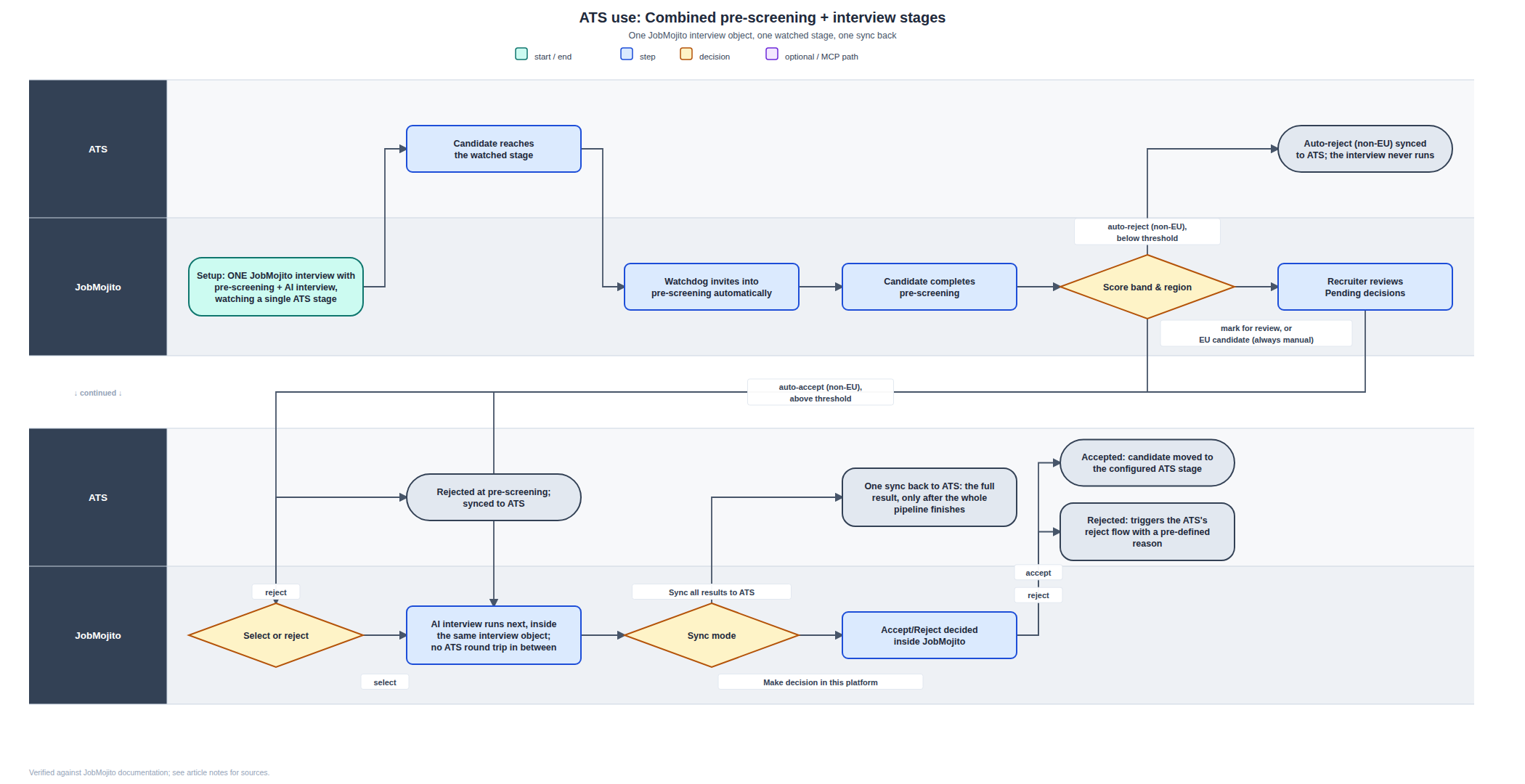
One-time setup: import a single position from your ATS with both a pre-screening stage and an interview stage, and choose the one ATS stage that triggers it.
Candidate reaches that stage, and the watchdog automatically sends the pre-screening invitation.
Candidate completes pre-screening, and JobMojito scores it into one of three bands, same rules as everywhere else: auto-accept into the interview (non-EU, above threshold), auto-reject (non-EU, below threshold, synced to the ATS immediately since the candidate's journey ends here), or sent to a recruiter's Pending decisions screen for manual review (mid-band, or any EU/GDPR candidate).
If accepted, the AI interview runs immediately, inside that same interview object. There's no separate stage for "passed pre-screening, waiting on interview": the handoff is invisible to your ATS.
Only once the interview finishes does JobMojito write back to the ATS, using whichever sync mode you configured: a full sync (score, tags, PDF, optional silent move to a completed stage) with your recruiter deciding from inside the ATS, or a decision made inside JobMojito that writes back just the outcome (accept moves the stage, reject runs the ATS's reject flow with your pre-defined reason).
Separate: two JobMojito objects, two round trips
Configure pre-screening and the interview as two independent positions instead, each with its own "Create interview" wizard entry, each watching its own ATS stage. Now the ATS hears from JobMojito twice, and something in between (a recruiter, or an ATS automation rule) has to actually move the candidate from the first watched stage into the second one.
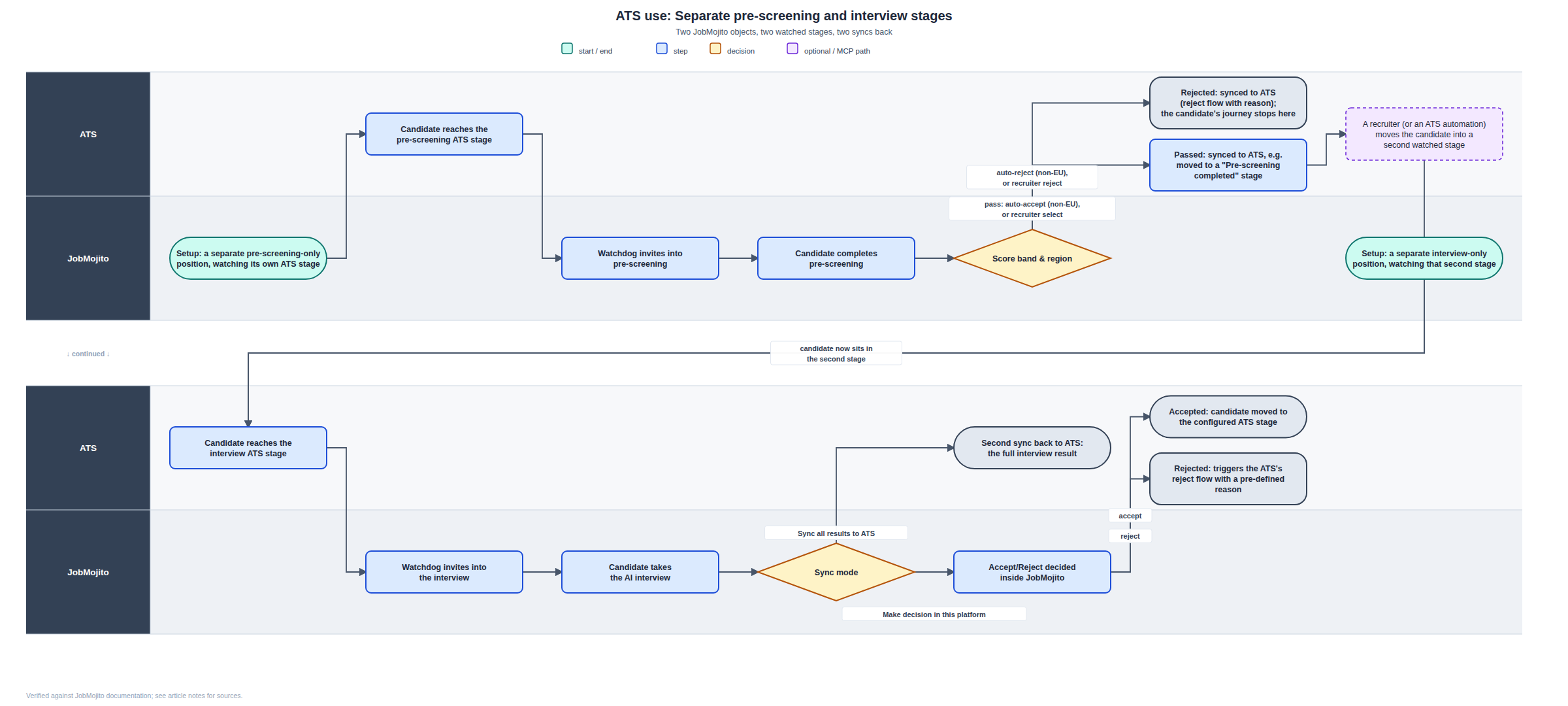
One-time setup (position 1): import a pre-screening-only position, watching its own ATS stage.
Candidate reaches that stage, the watchdog invites them into pre-screening, and JobMojito scores it the same way as above.
The pre-screening result is synced back to the ATS on its own, for example by moving the candidate to a "Pre-screening completed" stage, or running the reject flow if they didn't pass. This is the first round trip, and it's complete on its own: nothing about the interview has happened yet.
Something outside JobMojito moves the candidate into the second watched stage: a recruiter reviewing the "Pre-screening completed" list and progressing them by hand, or an automation rule your ATS runs on its own. JobMojito has no visibility into pre-screening and interview as one pipeline; as far as it's concerned, these are two unrelated positions.
One-time setup (position 2): import an interview-only position, watching that second stage.
Candidate reaches the second stage, the watchdog invites them into the interview, and the interview runs.
The interview result is synced back to the ATS separately, using the same two sync-mode options described above. This is the second round trip.
What actually differs
Both approaches use the exact same pre-screening rules, scoring bands, and end-of-flow sync options described in the main ATS use article; this document only covers the structural choice of bundling them into one JobMojito object or splitting them into two.
If your recruiters want to see and act on pre-screening results in the ATS itself before an interview is ever sent, or if you want an ATS automation rule (rather than JobMojito) deciding who proceeds, use the separate setup. If you'd rather not manage an extra stage and are comfortable letting JobMojito run the qualifying step and the interview back to back on its own, use the combined setup.
Was this helpful?
Still need help? Ask the team